3D Rendering vs. Product Photography for Furniture Ecommerce: Cost, Quality and ROI Compared (2026)
By Empire Render Team
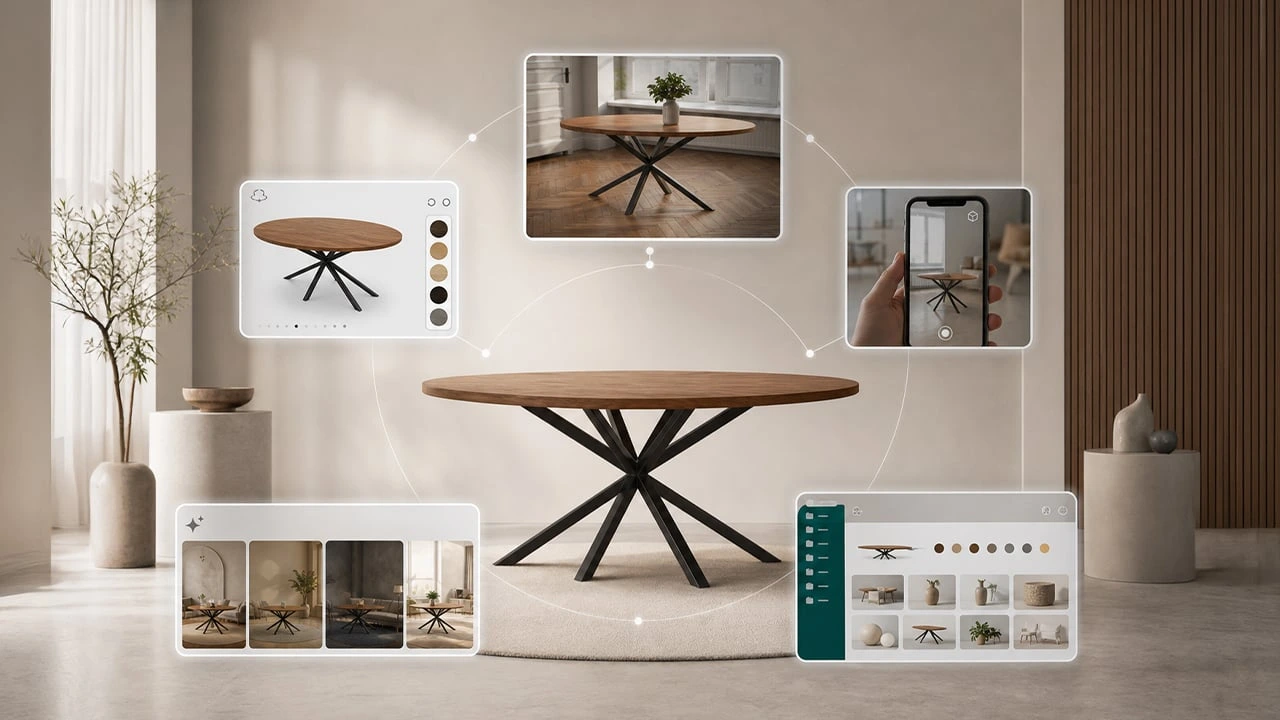
If you sell furniture online, you've probably had this conversation with your team at least once this year. Should we keep paying for photo shoots, or is it finally time to move to 3D?
It's not a small decision. It touches your budget, your launch timelines, and how your products actually look to the customer who's deciding whether to hit "Add to Cart." And honestly, the answer depends on your catalog, your configurations, and what you're actually trying to solve.
This guide breaks down the real cost, quality, and ROI differences between 3D rendering and product photography for furniture brands, using actual pricing benchmarks instead of vague estimates, so you can make the call with real numbers in front of you.
Quick answer
If your catalog has 200 or more SKUs, or products with five or more material and finish options, 3D rendering typically costs about 30 to 40 percent less than traditional photography once you account for every configuration. It also gets rid of the reshoot cycle entirely when you launch a new color or fabric. Photography still has its place. For hero lifestyle shots, brand campaigns, or smaller catalogs with minimal variation, a hybrid approach often makes more sense than switching everything over at once.
The real problem: the math on configurations doesn't work for photography
Here's the math that pushes most furniture brands toward 3D in the first place.
A sofa with eight fabric options and three leg finishes isn't really one product. It's 24 configurations. Multiply that across a 200 SKU catalog and you're not photographing a few hundred items anymore, you're photographing thousands of variations. Most brands simply can't afford to shoot them all, so they end up shooting 30 to 50 percent of what's actually available and hoping customers don't notice the gaps. That's the pattern we see again and again across premium home furnishings brands: annual photography budgets north of $50,000, and still only a fraction of the catalog fully represented online.
Every configuration that never gets photographed is a customer left guessing what a product will actually look like in the finish they want. That's a quiet but very real conversion leak.
What you're actually paying for
Photography costs don't stop on shoot day. The real budget usually includes sample coordination and shipping to get the physical product to the studio, studio rental and equipment, photographer and stylist day rates, retouching per image, and reshoots whenever a finish gets discontinued or a new one launches. It adds up fast, and most of it repeats every time your line changes.
3D rendering restructures that cost in a completely different way. Once a product's base 3D model exists, adding a new color, fabric, or finish is dramatically cheaper because there's no new sample to source, no new studio day, and no new shipping involved. As a reference point, furniture rendering projects typically run about $50,000 to $70,000 for a 100 SKU catalog, roughly 30 to 40 percent less than the equivalent photography spend. Ongoing rendering for products that already have a base model built usually runs somewhere between $130 and $240 per product, depending on the service level, revisions, and turnaround you need.
| Product photography | 3D rendering | |
|---|---|---|
| Cost per new color or finish | Full reshoot cost | Marginal, reuses the existing model |
| Physical samples required | Yes, for every configuration | Only once, to build the base model |
| Typical catalog coverage | 30 to 50 percent of configurations | Up to 100 percent of configurations |
| Cost to update after launch | New shoot | Rerender from an existing asset |
| Lifestyle and room scenes | New shoot per scene | Reusable scene, swap products in |
The pattern holds across categories. The more configurable your product, the faster photography costs outpace rendering costs, and that gap only gets wider as your SKU count grows.
Can 3D rendering actually match photography?
This is the objection every furniture brand raises, and honestly, it's a fair one. Bad 3D rendering is easy to spot. Flat looking fabric, wood grain that looks like plastic, metal that doesn't reflect anything. That reputation was earned, because plenty of rendering studios optimize for volume instead of accuracy.
But quality in 3D rendering isn't really a ceiling problem anymore. It's a vendor problem. The details that separate a convincing render from an obviously fake one are specific, and they're learnable. Fabric needs real depth, with quilting, weave texture, and shadow that behaves correctly under different light angles. Wood grain needs to look natural, with consistent grain direction and small imperfections rather than an obviously repeating texture. Metal reflection has to be right, since chrome, brushed nickel, and matte black each reflect light differently, and getting this wrong is one of the fastest ways to make a render feel synthetic. And lighting needs to fall and shadow the way it actually would if the product were sitting in a real room.
The standard worth holding any rendering partner to is simple. Can your team tell the difference from real photography? If they can, it isn't ready yet. Some furniture and home goods brands have gone through ten or more iterations on a single fabric's quilting pattern and shadow depth just to clear that bar before launch. That level of scrutiny is what actually closes the gap between "good enough" and "indistinguishable."
Speed and how well it scales
Photography scales in a straight line. Twice the configurations means roughly twice the shoot time and cost. 3D rendering doesn't follow that same curve. Once a product's base model and core materials exist, generating a new finish, updating a room scene, or producing an AR ready version of an existing product takes a fraction of the time and cost it would to start from scratch.
This matters most at three moments. The first is launching a configurator. If customers can mix and match finishes on your site, every combination needs a visual, and that's something photography simply can't keep up with. The second is a catalog refresh. Updating hundreds of SKUs for a rebrand or seasonal update is a rendering job measured in weeks, not a photography job measured in months. The third is a new product line with heavy customization, where multiple finish combinations that would be too expensive to fully photograph are exactly where rendering pays for itself fastest.
The number that actually matters
Cost and speed are inputs. Conversion is the output that actually justifies the switch. Furniture and home furnishings brands that move to high quality 3D rendering see an average 20 percent lift in conversion rate, driven largely by customers finally being able to see every configuration they're considering, in accurate detail, before they buy.
There's a second, quieter benefit too, and it's returns. When fabric texture or finish color gets even slightly misrepresented online, customers order the wrong thing and send it back. Return shipping, restocking, and lost margin on damaged returns add up fast in furniture, where freight costs are high relative to the price of the product itself. Accurate visualization, whichever method delivers it, directly cuts down on this kind of avoidable return.
When photography still makes sense
3D rendering isn't a universal answer, and any good rendering partner should tell you that upfront. Photography, or a hybrid approach, still makes sense if your catalog is small and doesn't have much variation, say under about 50 SKUs with few finish options. It also still makes sense if you need authentic lifestyle or brand campaign imagery with real people, real spaces, and real light, or if you're trying to capture a genuinely unique physical texture or material story as part of your brand's identity.
Most premium furniture brands land somewhere in the middle. Photography handles the hero brand moments, and 3D rendering handles the configuration heavy catalog work that photography simply can't scale to cover.
Side by side summary
| Factor | Photography | 3D rendering |
|---|---|---|
| Best for | Small catalogs, brand campaigns | 200+ SKUs, 5+ configurable options |
| Cost at scale | Rises in a straight line per configuration | Flattens out after the base model is built |
| Update speed | Weeks per reshoot | Days for new finishes or colors |
| Full catalog coverage | Rare, usually 30 to 50 percent | Standard, up to 100 percent |
| Configurator and AR readiness | Requires separate production | Built in from the same asset |
| Typical conversion impact | Baseline | About a 20 percent average lift reported by switchers |
Frequently asked questions
How much does 3D rendering cost for furniture products?
Pricing depends on model complexity, how many finish and material variations you need, and the service level you choose. But as a general benchmark, a 100 SKU furniture catalog typically runs $50,000 to $70,000 for the full project, with ongoing per product rendering after the base model exists landing somewhere around $130 to $240, depending on revisions and turnaround.
Is 3D rendering as good as product photography?
It can be, but quality varies a lot depending on the vendor. The bar worth holding any rendering partner to is this: your team shouldn't be able to tell a render apart from a real photograph. Fabric depth, wood grain, and metal reflection accuracy are the details that make or break that.
How long does 3D rendering take compared to a photo shoot?
A full photography shoot for a large, configurable catalog can take months just to cover a partial set of variations. A 3D rendering project for a comparable catalog typically delivers in a matter of weeks, and adding new finishes afterward takes days instead of requiring a whole new shoot.
Do I have to fully replace photography with 3D rendering?
Not at all. Most furniture brands run a hybrid approach, using photography for lifestyle and brand imagery and 3D rendering for full catalog configuration coverage, product detail pages, and configurators.
Does 3D rendering work for AR and 360 degree product views?
Yes, and it's one of its biggest advantages over photography. A single 3D model can generate a 360 degree spinner, an AR ready output, and multiple room scene variations without any additional physical shoots, all from one base asset.
The bottom line
If your catalog has grown past the point where photographing every configuration is financially or logistically realistic, the math increasingly favors 3D rendering. Not as a compromise, but as the more scalable, more complete way to show customers exactly what they're buying. The brands seeing the strongest results aren't choosing rendering because it's cheaper on paper. They're choosing it because it lets them show 100 percent of their catalog instead of 40 percent, and that completeness is what shows up in the conversion numbers.
The real question worth asking your team isn't just "photography or rendering." It's "what's the cost of the configurations we're not showing customers today?"

